
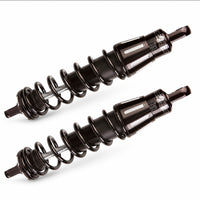

Two-wheel touring? Most riders start with SR2 LT.
Built to your weight, ships in 3–9 business days • Free shipping • 30-day returns • Limited lifetime warranty • Made in USA
Why Harley Touring Suspension Feels Harsh (And How Riders Fix It)
If your Road Glide or Street Glide feels stiff over broken pavement, sharp over expansion joints, or just beats you up on longer rides, you’re not imagining it. A lot of Harley touring bikes leave the factory with suspension that’s built to work well enough for every rider — not specifically for your weight, your setup, or how you actually ride.
Most harsh Harley rides come from stock suspension compromises.
Why the ride feels harsh on many 2017–2023.5 touring bikes:
• Most Road Glide and Street Glide models came with short 12" rear shocks
• Stock spring rates were often extremely stiff for solo riders
• Many models used about a 400 lb spring on the left side and a 100 lb spring on the right side
• The setup had to cover solo riders, 2-up riding, luggage, and Tour Pack loads with one compromise system
That kind of stock setup is predictable and durable, but it also explains why so many riders describe the bike as harsh, rigid, or fatiguing once the miles stack up. The good news is this is one of the most fixable problems on a Harley touring bike — once you understand what’s actually causing it.
1) Why stock Harley suspension feels so stiff
2) What short travel and spring rates actually do on the road
3) How riders fix harsh touring-bike suspension
Where most riders go next
Once riders understand why the stock setup feels harsh, the next step is usually figuring out
whether a rider-specific shock setup makes more sense for their bike, their load, and the kind of miles they actually ride.
If you want to see how that works in more detail, read
why Super Shox suspension is different
.

What harsh Harley suspension actually feels like
Most riders don’t describe the issue as “bad suspension” at first. They describe what the bike feels like after a few rough roads, longer rides, or loaded travel days.
Common signs your suspension is the problem:
- Potholes feel sharper than they should
- Expansion joints send a jolt through your back
- The rear end feels rigid on rough pavement
- 2-up or luggage makes the bike feel overwhelmed
- Long rides leave you more fatigued than expected

Find your shock: SR2 LT for touring ($895) • SR1 for trikes (from $745) • RR1, race-derived ($1,450)
Why Harley sets stock suspension up this way
- It has to work for solo riders and loaded touring bikes
- It has to handle passengers, Tour Packs, and luggage
- It has to feel acceptable across a huge rider-weight range
- It’s built as a broad compromise, not a rider-specific setup
12" rear shocks Most Road Glide and Street Glide models in that range came with 12-inch shocks unless it was an Ultra.
Stiff spring setup Many of those bikes also came with roughly a 400 lb spring on the left side and a 100 lb spring on the right side.
1) Shorter shocks give you less usable travel
2) Stiffer springs resist movement more aggressively
3) Less travel + more spring = sharper impact on rough pavement
The bike stays usable across a lot of rider setups, but it often feels rigid, tiring, and underwhelming on the exact kind of roads touring riders spend real time on.

How riders actually fix a harsh Harley ride
Once riders understand why the stock setup feels harsh, the path usually comes down to three options. Not all three are equal.
Adjust the stock preload
This can help a little, especially if the bike is badly set up for your current load, but it doesn’t change the short travel or the underlying spring compromise.
Move to a longer-travel shock setup
More usable travel gives the suspension more room to absorb rough pavement instead of firing that impact straight into the rider.
Use rider-specific suspension
This is where the biggest difference usually happens — matching spring support and ride behavior
to solo riding, 2-up use, Tour Pack load, luggage, and real-world touring miles.
If you want to understand how rider-specific suspension actually works,
you can read the full guide on
why Super Shox suspension is different
.
Find your shock: SR2 LT for touring ($895) • SR1 for trikes (from $745) • RR1, race-derived ($1,450)
What riders usually notice once the suspension is sorted
Most riders expect suspension upgrades to make the bike more “performance oriented.” What actually surprises them is how much more relaxed the bike becomes.
Common changes riders report
- Potholes feel muted instead of violent
- Expansion joints stop sending sharp jolts through your back
- The bike stays planted on rough pavement
- Loaded touring feels controlled instead of overwhelmed
- Long days in the saddle create far less fatigue
Many riders describe it as finally feeling like the motorcycle is working with them instead of against them.

Ready to choose? Pick your bike.
Race-derived RR1 with adjustable damping: RR1 Street Glide $1,450 • RR1 Road Glide $1,450
Built to your weight, ships in 3–9 business days • Free shipping • 30-day returns • Limited lifetime warranty • Made in USA
Ready to fix the ride?
Once riders understand why the stock Harley setup feels harsh, the next step is usually moving to a suspension setup that actually matches how the bike is ridden — solo, two-up, loaded, and on real roads instead of perfect ones.
That’s why rider-specific suspension is one of the most noticeable upgrades you can make to a touring Harley. It addresses the exact compromises built into the factory setup.
Comparing brands first? Start with our guide to the best rear shocks for Harley touring bikes.
